SEMINAR “STUDI KURATORIAL DESAIN PAMERAN TEMPORER: MENGIKUTI JEJAK MAHARAJADIRAJA: MENGINTERPRETASIKAN ULANG ADITYAWARMAN”
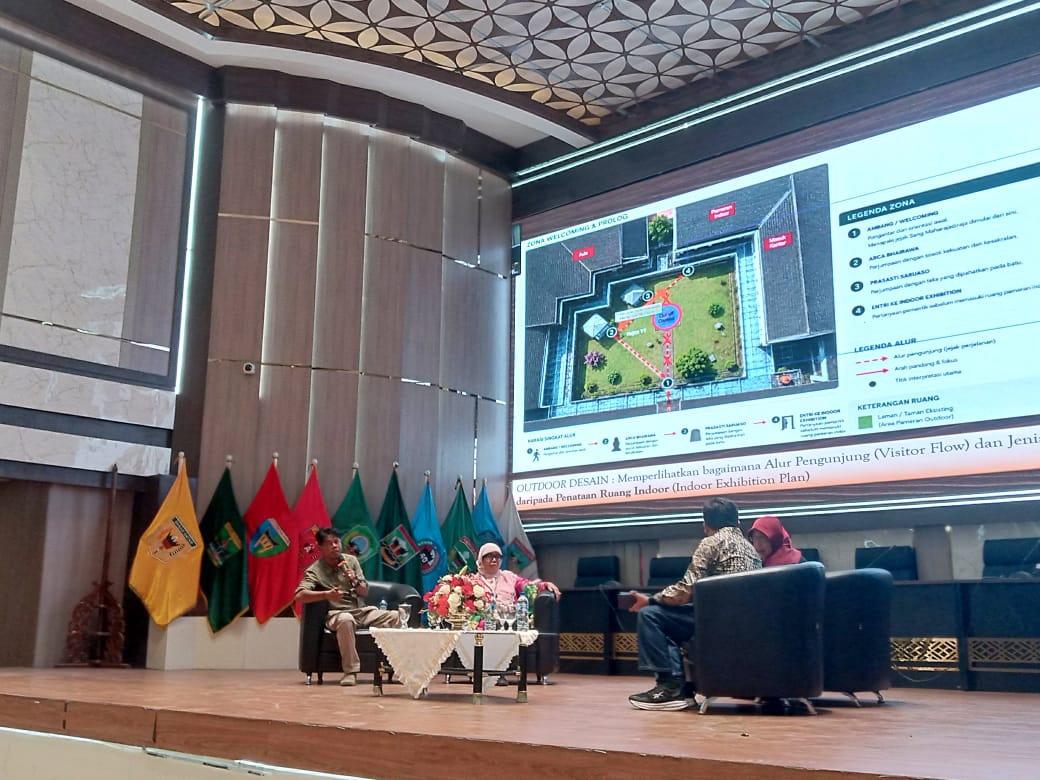
The seminar “Curatorial Study of Temporary Exhibitions: Following in the Footsteps of the Maharajadiraja: Reinterpreting Adityawarman” was held on Friday, August 28, 2026, at the West Sumatra Governor’s Office Auditorium. This event is part of an effort to develop ideas and concepts for a temporary exhibition that highlights Adityawarman as one of the key figures in the history of Sumatra. The seminar not only discussed Adityawarman from a historical perspective but also aimed to examine how historical traces, archaeological remains, museum collections, and cultural heritage related to him can be constructed into an exhibition narrative that is educational, communicative, and evidence-based.
The theme “Following in the Footsteps of the Maharajadiraja: Reinterpreting Adityawarman” was chosen because Adityawarman played a significant role in the history of Sumatra, particularly in its political, social, religious, and cultural development during the 14th century. Traces of his existence can be traced through various historical sources and archaeological remains, such as inscriptions, statues, artifacts, sites, and museum collections. However, interpretations of Adityawarman are not uniform. These various sources can be interpreted through the lenses of history, archaeology, museology, culture, and community knowledge. Therefore, a curatorial study is needed that can bring these diverse perspectives together to create a temporary exhibition that is both academically grounded and accessible to the general public.
This event featured Aurora Murnayati Arby as a speaker with a background as a practitioner. The practitioner’s perspective in this event focused on how a historical concept can be translated into an exhibition experience that visitors can enjoy and understand. In the context of temporary exhibitions, the curatorial aspect is not limited to the selection of objects but also encompasses the development of a narrative, the arrangement of the collection, the presentation of information, and the ways in which connections are established between the objects and the visitors. This perspective is crucial to ensure that the exhibition on Adityawarman goes beyond the mere display of artifacts and instead offers an interpretive experience that connects the collection to its historical and cultural context.
Next, Alfa Noranda, M.A., representing Jago Pusako and a lecturer in Archaeology at Andalas University, provided a detailed explanation of the curatorial approach to the temporary exhibition titled “Following in the Footsteps of the Maharajadiraja: Reinterpreting Adityawarman.” In her presentation, she explained that the exhibition concept employs an evidence-based curatorial approach, drawing on archaeological studies, history, museology, collection studies, spatial analysis, visitor studies, and preventive conservation. The exhibition is organized into several zones designed to help visitors understand Adityawarman through historical traces, inscriptions, statues, language, symbols, power, and cultural heritage that endures to this day.
The seminar materials also noted that the exhibition design still needs refinement, particularly regarding the identification and cataloging of the collection, the development of the storyline, the alignment of the collection with the informational content, the accuracy of the infographics, and adjustments to the spatial layout and epilogue. These refinements are necessary to ensure that every object on display is supported by clear evidence and consistently reinforces the exhibition’s theme and objectives. With this approach, the temporary exhibition layout is expected not only to present the collection as historical artifacts but also to build a narrative flow that allows visitors to understand Adityawarman in a more comprehensive, critical, and contextual manner.
An archaeological perspective was also provided at this seminar by Dr. Ery Soedewo, S.S., M.Hum., from the National Research and Innovation Agency (BRIN). The inclusion of an archaeological perspective is crucial in ensuring that the exhibition’s narrative regarding Adityawarman is grounded in reliable sources and material evidence. Artifacts such as inscriptions, statues, and other objects, as well as archaeological sites, need to be placed in their proper spatial and temporal contexts so that visitors not only view these objects as relics of the past but also understand their functions, meanings, and connections to the development of society during Adityawarman’s time.
Meanwhile, Dr. Azhar Ibrahim from the Department of Malay Studies at the National University of Singapore (NUS) also offered academic and cultural perspectives on re-examining the figure of Adityawarman. These perspectives provide a framework for understanding how a historical figure is shaped through various narratives, memories, and constructions of knowledge. In the context of exhibition design, this perspective is crucial to ensure that the presentation of Adityawarman does not merely showcase a single viewpoint but allows visitors to grasp the complexity of history and the various processes through which this figure is interpreted.
Dra. Zulneli Zubir, M.Hum., from BRIN also contributed to the discussion on historical, archaeological, and cultural heritage studies, which form the basis for the development of exhibition design. These research perspectives are crucial for strengthening the connection between the collection, historical sources, and the narrative to be conveyed to visitors. Museum collections are not merely viewed as objects on display, but as sources of data that must be studied, interpreted, and placed in the appropriate context. Thus, each selected collection can contribute to the formation of the exhibition’s overall narrative.
The diverse backgrounds of the speakers and panelists made this seminar a space for dialogue among practitioners in the fields of museums, local knowledge, archaeology, research, academia, and cultural studies. This convergence of perspectives demonstrated that designing temporary exhibitions requires a process that is not merely visual but also demands a strong foundation in research and curatorial practice. The collection, narrative, space, infographics, and even the visitor experience must all be interconnected to create a consistent and easily understandable exhibition flow.
Through the seminar “A Curatorial Study of Temporary Exhibitions: Tracing the Footsteps of the Maharajadiraja: Reinterpreting Adityawarman,” the discussion ultimately focused not only on questions regarding who Adityawarman was and what his historical legacy entailed, but also on how that history can be conveyed to today’s audience through museums. Temporary exhibitions are expected to serve as a medium that brings together historical evidence and curatorial interpretation, so that visitors gain an experience that is not only informative but also encourages reflection on the significance of historical and cultural heritage.
Overall, this seminar provided important input for refining the concept of the temporary exhibition “Following in the Footsteps of the Maharajadiraja: Reinterpreting Adityawarman.” The findings of the study and discussions can serve as a foundation for refining the collection to be displayed, the storyline, informational materials, infographics, spatial layout, and even the epilogue. Thus, the exhibition is expected to present Adityawarman’s narrative in a manner that is more evidence-based, contextual, educational, and communicative, while also strengthening the museum’s role as a space for learning and dialogue between the history of the past and today’s society.
Author: Muhammad Isamuddin
English: edit using Deepl
Leave a Reply